
"The artist cannot and must not take anything for granted, but must drive to the heart of every answer and expose the question the answer hides."
– James Baldwin, "The Creative Process," 1962.
a little more about me…

Photo: Stephanie Gracés
I grew up in Sacramento, CA—the oldest daughter of an interracial and multi-national Nigerian-Sicilian-American family with 6 kids and four parents. When I went to college at the University of Oregon in 2008, I wanted to be an attorney, but became bewitched by the arts, or art history. I went in a Political Science major and came out with two degrees, BAs in French and Art History.
Yet, I still felt I might want to do something more meaningful and, quite frankly, easier than becoming an art history or French professor. So, I work for 4 years in Seattle for the Washington Council for Behavioral Health, an advocacy group supporting community mental health and chemical dependency organizations. But attaining an MSW was not for me. So, in 2016, I moved to New Orleans where I obtained a master's in art history at Tulane University.
I quickly fell in love with the city, its people and culture, and the complexities of its history. I ultimately wrote my thesis about an 1837 portrait—painted by a Bavarian immigrant—that depicted an unidentified woman of African descent from the Crescent City. In addition to trying to identify the woman portrayed, I publicly revealed changes made to the painting in the 20th century by a professional restorer in 1988 after it was purchased by the Historic New Orleans Collection (THNOC). These changes served to obscure markers of wealth from the Black and interracial sitter's image.
To frame and address the damage done to the painting, I discussed the “restorer’s” changes as an example of how those with power shape the production of history. In addition, I framed the damage wrought at the hands of restorer and sanctified by THNOC, who refused to publicly acknowledge the significant changes, as the destruction of cultural property and heritage, to emphasize the role museums play in the formation of racialized identity and difference—or individual peoples sense of belonging to or exclusion from national history.
In 2017, I published an article in the Iron Lattice about my initial findings and THNOC finally had the painting properly conserved. In 2021, after I finished my thesis, they added a panel next to the painting in their public galleries detailing this history. In 2025, I finally published my writings and research about the portrait in The Routledge Companion to Race in Early Modern Artistic, Material, and Visual Production. [Accessible in the tab for Texts.]
In the midst of it all, i began a curatorial practice, working as a curatorial fellow at the New Orleans Museum of Art from 2017–18, a curatorial assistant at the UC Berekeley Art Museum & Pacific Film Archive from 2019–2021, a curatorial associate for Prospect New Orleans from 2021–22, and a curatorial fellow for the Philadelphia Museum of Art. I’ve recently attained an additional masters in Black Studies from Yale University and aim to complete a PhD.
I’ve worked on countless curatorial and research based projects, but I return to this painting from New Orleans often because of what it taught me. This project led to tangible change and important collaborations that for many would have felt impossible. I’ve since come to see all my academic and curatorial projects as a form of social work and teaching praxis (meaning a practice informed by theory and/or theology) à la Paulo Freire’s Pedagogy of the Oppressed.
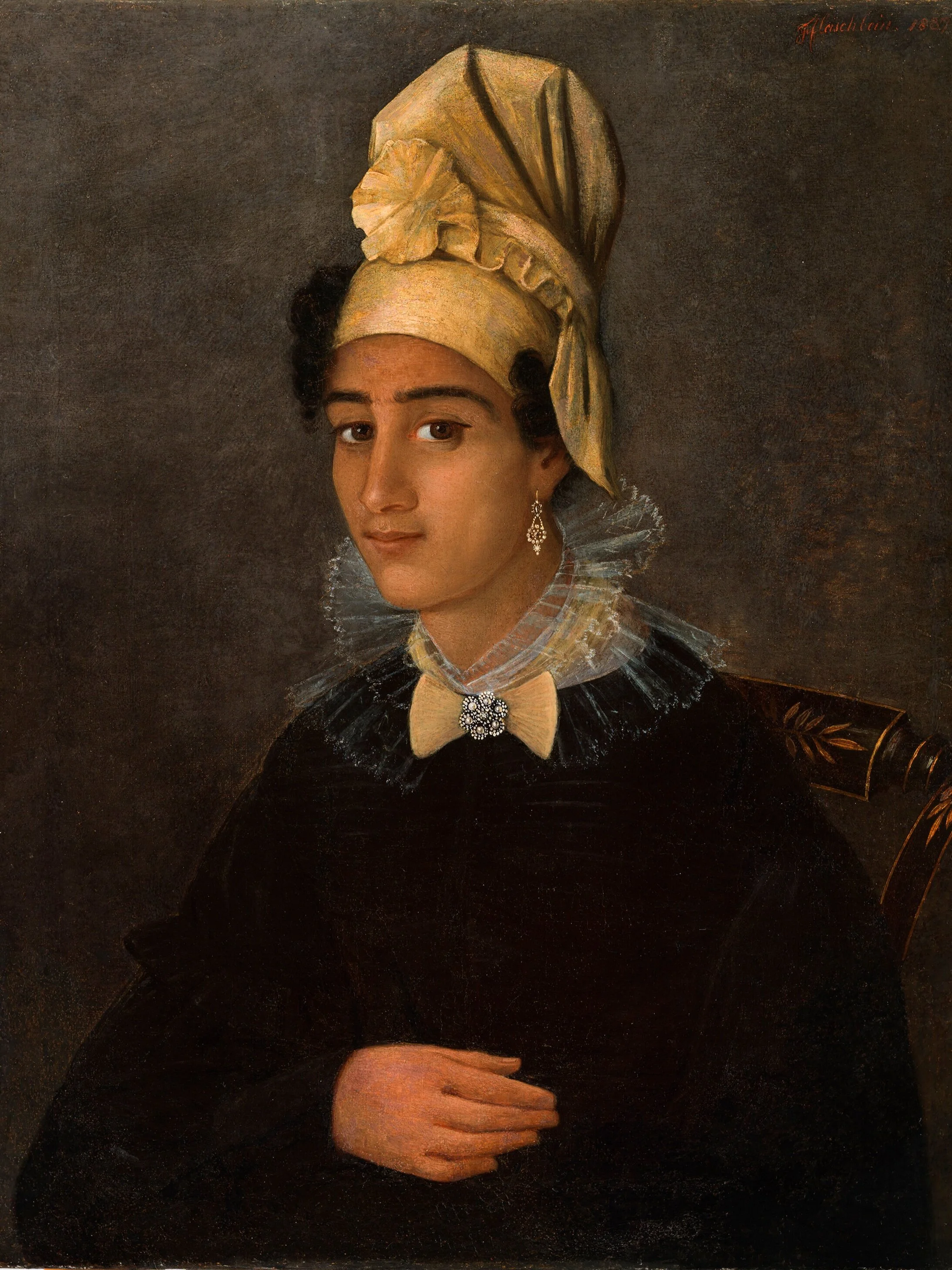


Master’s Thesis | Tulane University 2019
The Art of Erasure
Lucia’s master’s thesis looks at the history of a portrait of an unidentified free woman of color painted in 1837 by Francois (born Franz) Fleischbein, a Bavarian-born recent immigrant in New Orleans. It examines how Southern art historians, art critics, and museum specialists have imposed their own prejudices on the narratives they created pertaining to the woman portrayed; and, how one professional art restorer drastically altered the physical appearance of the sitter and her portrait to better fit these unfounded and ultimately racist narratives.

“History is the fruit of power, but power is never so transparent that its analysis becomes superfluous. The ultimate mark of power may be its invisibility; the ultimate challenge, the exposition of its roots.”
– Michel-Rolph Trouillot, Silencing the Past (1995)